
The appointment starts and your mind goes blank. The yogurt that caused a coughing fit, the lunchbox that came home untouched three times, the week your child lived on toast — all of it has somehow vanished. What comes out is: “They’re a bit picky.”
A food diary gives the conversation somewhere better to begin. It does not need to prove that something is wrong, and it does not need to look impressive. It needs to help a pediatrician see what ordinary eating looks like and understand the question you want answered.
Here is a reassuring fact: several specialist children’s services ask for a three-day food record, not a month of perfect tracking. One NHS dietetics service suggests including one weekend day; the University of Rochester asks for two weekdays and one weekend day. Their feeding program also tells parents: “There are no right or wrong answers.”
First: what kind of appointment is this?
A routine pediatric appointment, a dietitian visit and a specialist feeding or swallowing assessment are not the same. Call the office or read its instructions before you start recording.
A specialist clinic may send its own form, ask for a video, request specific foods or want your child ready to eat during the visit. For example, Seattle Children’s asks families to bring accepted and challenging foods plus familiar mealtime items. Evelina London suggests a short video of a typical meal or snack. Those are clinic-specific requests, not rules to copy for every pediatric visit.
Do not deliberately make your child hungry before a general appointment. Do that only if the clinic has explicitly instructed you how to prepare. The same applies to bringing food into a clinic, where allergy policies may matter.
Make page one do the hard work
The most useful first page is not a table. It is a short briefing that a clinician can understand in under a minute.
Start with one sentence:
“I am worried because Maya’s accepted foods have dropped from around 15 to 7 since May, and she now coughs during some meals.”
Or:
“Leo is growing, but dinner regularly lasts an hour and we need help deciding whether this is typical picky eating or needs another assessment.”
Then add:
- your child’s age;
- when you first noticed the concern and whether it is changing;
- the three things that affect daily life most;
- known allergies, diagnoses or dietary restrictions;
- current medicines and supplements, including doses if available;
- three questions you do not want to forget.
This is not self-diagnosis. It is a way to separate what you observed from what you fear it might mean.
Three ordinary days are often enough to start
If your clinician has not requested a different period, three representative days are manageable and useful. Include a weekend or childcare day if eating changes there. Do not choose only the “best” days, and do not serve a special menu to make the record look balanced.
The University of Rochester’s record instructions specifically tell families not to change normal eating habits while keeping the record and not to begin when a child is sick, because illness can change intake.
For each meal, snack and drink, capture this:
| Record | Plain example | Why it helps |
|---|---|---|
| Time and place | 7:35, kitchen |
Shows the shape of the day without guessing. |
| What was offered | toast, egg, strawberries |
Separates the adult’s offer from the child’s intake. |
| What was eaten or drunk | 1 toast triangle; smelled egg; water |
“None” and “unsure” are valid entries. |
| Preparation details | lightly toasted; egg soft; berries sliced |
Texture, brand or temperature can matter when a pattern repeats. |
| Approximate amount | half, 3 bites, small cup |
A usable estimate is better than invented precision. |
| Brief context | late nap; meal calm; coughed after water |
Connects the food record to the actual concern. |
You do not need to weigh every strawberry unless the clinician has asked for gram-level quantities. Household estimates are usually more realistic: half a sandwich, one small yogurt, six grapes, three sips. If you use the same cup often, measure it once with water and write its capacity down — a practical shortcut included in Rochester’s three-day record instructions.
If school or daycare feeds your child, ask what was seen eaten, not only what appeared on the menu. “Pasta served” and “pasta eaten” answer different questions. A rough caregiver note is still more useful than filling the gap from memory.
The diary is about more than food
A clinician may need the story around eating as much as the list of foods. Keep this part short and factual.
Note patterns connected to your concern, such as:
- coughing, choking, gagging, vomiting or food staying in the mouth;
- pain, discomfort, constipation or reflux symptoms you observed;
- meals that regularly last much longer than expected;
- strong dependence on one texture, preparation, brand or utensil;
- differences between home, school, grandparents’ homes and restaurants;
- recent illness, dental changes, medication changes or stressful events;
- whether the range of accepted foods is stable, growing or shrinking.
Do not record your child’s mood as a verdict — “difficult,” “manipulative,” “good eater.” Record what happened. “Left the table after four minutes and returned twice” gives the clinician something concrete to ask about.
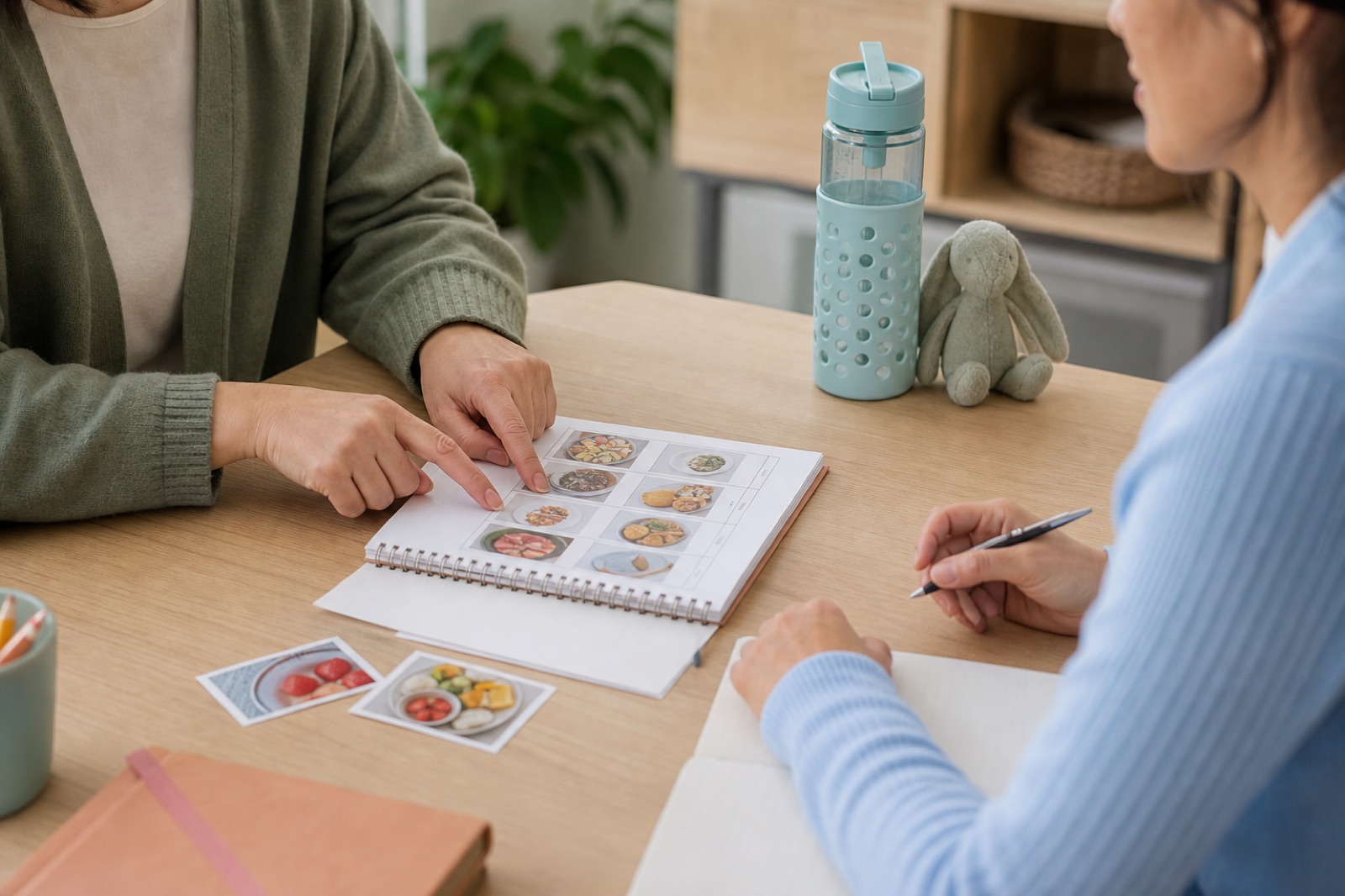
“Here is what I think, but what do you think and what will work for your whole family?”
— A parent’s description of a productive clinical conversation, Feeding Matters Family Guide
That is the point of bringing context: not to hand over a case file, but to make your family’s reality visible in the room.
What else belongs in the bag?
Keep the food diary at the top. Add only items that serve the concern or match the clinic’s instructions:
- the clinic’s completed questionnaire;
- a current medicines and supplements list;
- known allergy or intolerance information;
- relevant test results or growth records held by another provider;
- contact details for therapists or other clinicians involved;
- your current accepted-food list, if the range itself is a concern;
- a short video of a typical meal, if requested or if the problem is hard to describe;
- the child’s usual cup or utensil for a feeding assessment, if the clinic asks for it.
A video does not need to capture the worst meal your family has ever had. Thirty to sixty seconds showing seating, drinking, chewing or the moment you are concerned about can be enough to start a discussion. Protect your child’s privacy: keep it off social media, avoid filming other children, and ask childcare staff before recording anything there.
Seven questions worth writing down
Put your top three on page one. Keep the rest as prompts:
- Does my child’s growth pattern change how you interpret this diary?
- Which details here matter most, and which can I stop tracking?
- Could pain, constipation, medication, oral-motor or swallowing issues be relevant to what we see?
- Are there signs that mean I should contact you sooner?
- Would a referral help — and if so, to a pediatric dietitian, speech-language pathologist, occupational therapist, gastroenterologist, allergist or feeding team?
- What is one realistic step for our family before the next visit?
- How and when should we review whether that step helped?
Not every child needs tests or a specialist team. The pediatrician’s job is to combine the diary with growth, medical history, examination and your child’s individual situation. A diary is one input, not a verdict.
Do not wait for a beautifully finished diary
Contact your child’s clinician promptly if you are worried about growth, dehydration, pain, recurrent choking, coughing or difficulty swallowing, frequent gagging or vomiting, nutritional adequacy, or eating that is becoming very restricted or disrupting daily life. Feeding Matters advises families not to wait for the next routine wellness visit when feeding concerns feel significant.
For breathing trouble, a serious allergic reaction, severe dehydration or another emergency, seek emergency care rather than completing a diary.
A record you can actually bring
KidEat keeps meal notes and plate photos in Telegram, separates each child’s history and can include school or kindergarten context. Before an appointment, that history can help you build the three-day record and one-page summary without reconstructing every meal from memory. Its estimates remain approximate and are not a clinical nutrition assessment; see the public methodology for the product’s boundaries.
Source notes
Written by the KidEat editorial team and last checked on 15 August 2026. This article is educational, not medical advice. Always follow the instructions from your child’s own clinic.
- University of Rochester Medical Center: Feeding forms and three-day food record
- Kingston and Richmond NHS Foundation Trust: Children’s food diary
- Seattle Children’s: What to expect at the Pediatric Feeding Program
- Evelina London Children’s Hospital: Specialist feeding-team appointment
- Feeding Matters: Pediatric Feeding Disorder Family Guide
Questions parents often ask
How many days should a child food diary cover before an appointment?
Follow the clinic's instructions first. If it has not supplied a form, three ordinary days can be a workable snapshot; some specialist services request two weekdays and one weekend day.
Should I change what my child eats while keeping the record?
Unless your clinician says otherwise, record ordinary life rather than trying to create an ideal menu. The diary is more useful when it shows the routine you actually want help with.
What if the diary is incomplete?
Bring it anyway. A partial, honest record plus your main concern and questions is more useful than waiting for a perfect document and delaying the conversation.