
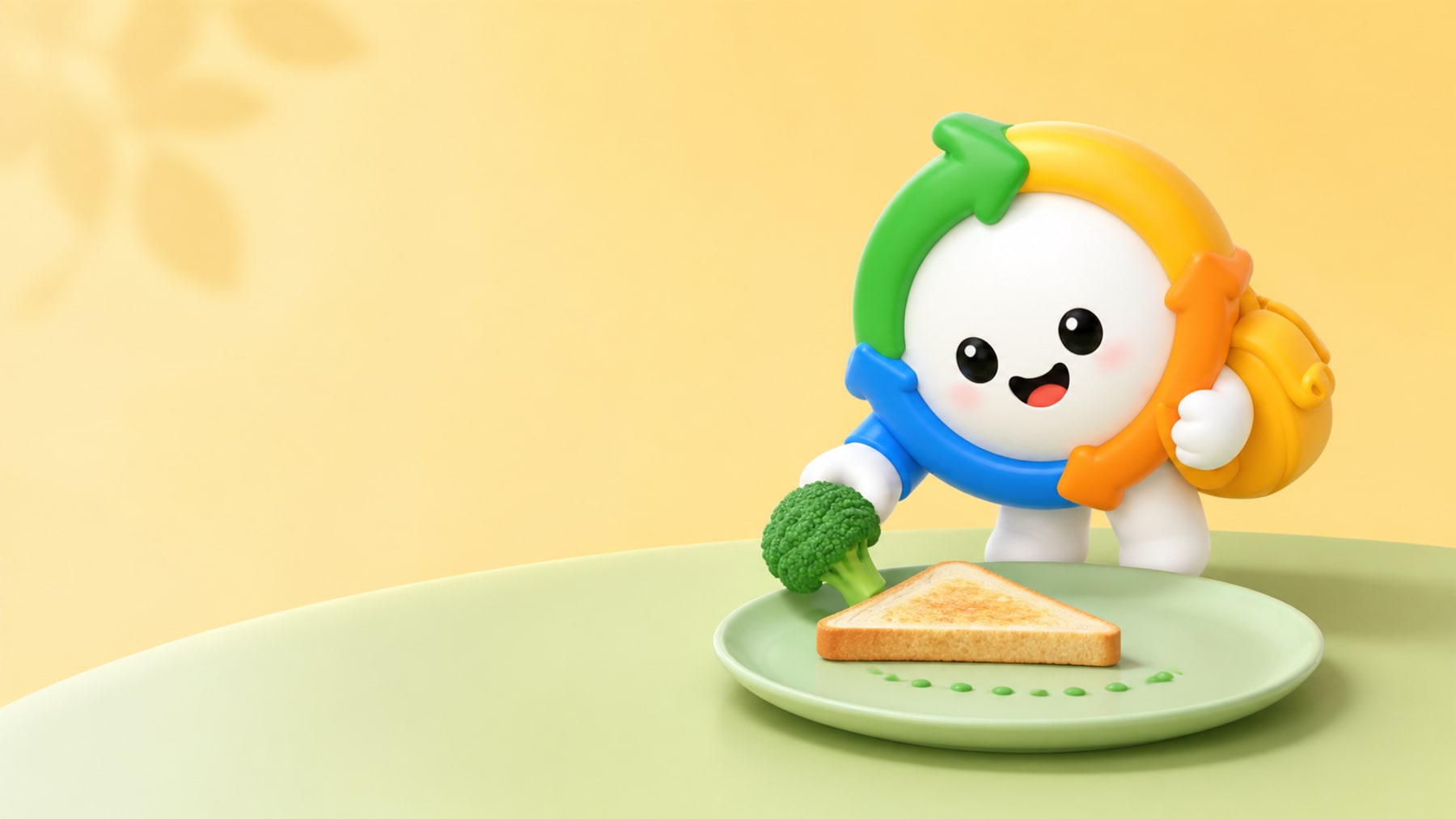
In two minutes: there is no magic number of tries. Research supports repeated, pressure-free taste exposure—especially for vegetables—but “8,” “10” or “15” is not a deadline. Offer a tiny, safely prepared portion beside familiar food, let your child decide whether to interact with it, and notice small changes without turning dinner into a trial.
The broccoli lands on the floor again.
You have steamed it, roasted it, called it a tiny tree and eaten it with such theatrical delight that you deserve a supporting-actor credit. Your toddler has now rejected it seven times. Somewhere online, another parent says the eighth try changed everything.
So: how many times should you offer a toddler a new food?
The honest answer is less satisfying than a countdown and much kinder to families: repeat exposure can help, but no scientifically correct number guarantees that attempt 8, 10 or 20 will end in a bite. The goal is not to outlast your child. It is to let an unfamiliar food become safely, quietly familiar.
“Ten tries” is a research shorthand, not a parenting rule
The number did not appear from nowhere. A USDA systematic review found moderate evidence that tasting a fruit or vegetable once a day for 8–10 or more days can increase acceptance in infants and toddlers aged 4–24 months. An updated review also found moderate evidence that repeated tasting of vegetables can increase acceptance in children aged 2–6.
If this suddenly feels harder in toddlerhood, you are not imagining the season. The American Academy of Pediatrics describes choosy eating as especially common between ages 2 and 4. Common does not mean effortless; it simply means the broccoli on your floor is not evidence that your kitchen is uniquely broken.
But those findings need their footnotes.
- The studies mostly tested vegetables; the evidence is much thinner for other foods.
- Many used purées or controlled portions, not Tuesday dinner with a tired three-year-old.
- The reviews say some children may need fewer exposures and some may never like that food.
- Researchers were usually testing an average change across a group, not predicting the exact dinner when one particular child would say yes.
A large meta-analysis of repeated vegetable exposure found a small but reliable average benefit. The estimated increase in vegetable intake was about 10 grams. That is meaningful in a study; at home it might look like one extra bite so unremarkable that nobody posts about it.
Here is the lovely, surprising part: in the earlier USDA review, mothers were sometimes unaware that acceptance had improved, even when measured intake or feeding speed had changed. Progress can be too quiet for a parent who is waiting for enthusiasm.
Familiar is a quieter victory than eaten.
A useful KidEat rule for the eighth untouched floret
There is no failed deadline. Attempt 11 is not proof you introduced the food wrongly, and attempt 21 is not a debt your child owes the internet. Nothing about that untouched floret measures how loved your child is—or how well you are mothering. ♡
Seeing, touching and tasting are related—but not identical
In research, taste exposure usually means the food reached the child’s mouth. That matters because the strongest evidence is for repeated tasting. For children aged 2–6, the updated USDA review also found that repeated non-taste experiences—seeing, smelling or touching a fruit or vegetable—can improve willingness to try it.
In real family life, it helps to record both without pretending they are the same:
| What happened | A neutral note | What it tells you |
|---|---|---|
| Stayed on the plate | present, no contact |
The food was tolerated nearby. |
| Moved or separated | moved to side bowl |
Your child interacted with it. |
| Touched or smelled | touched stem; smelled top |
Sensory familiarity is growing. |
| Licked, nibbled or spat out | tiny taste; spat calmly |
A taste happened; swallowing is not required for it to count as information. |
| Ate some | one bite, declined more |
Acceptance changed today—not necessarily forever. |
Do not turn this into a ladder your child must climb in order. A bite can be followed by three no-contact meals. A food eaten at daycare may still be rejected at home. The middle of learning is often messy and wonderfully non-linear.
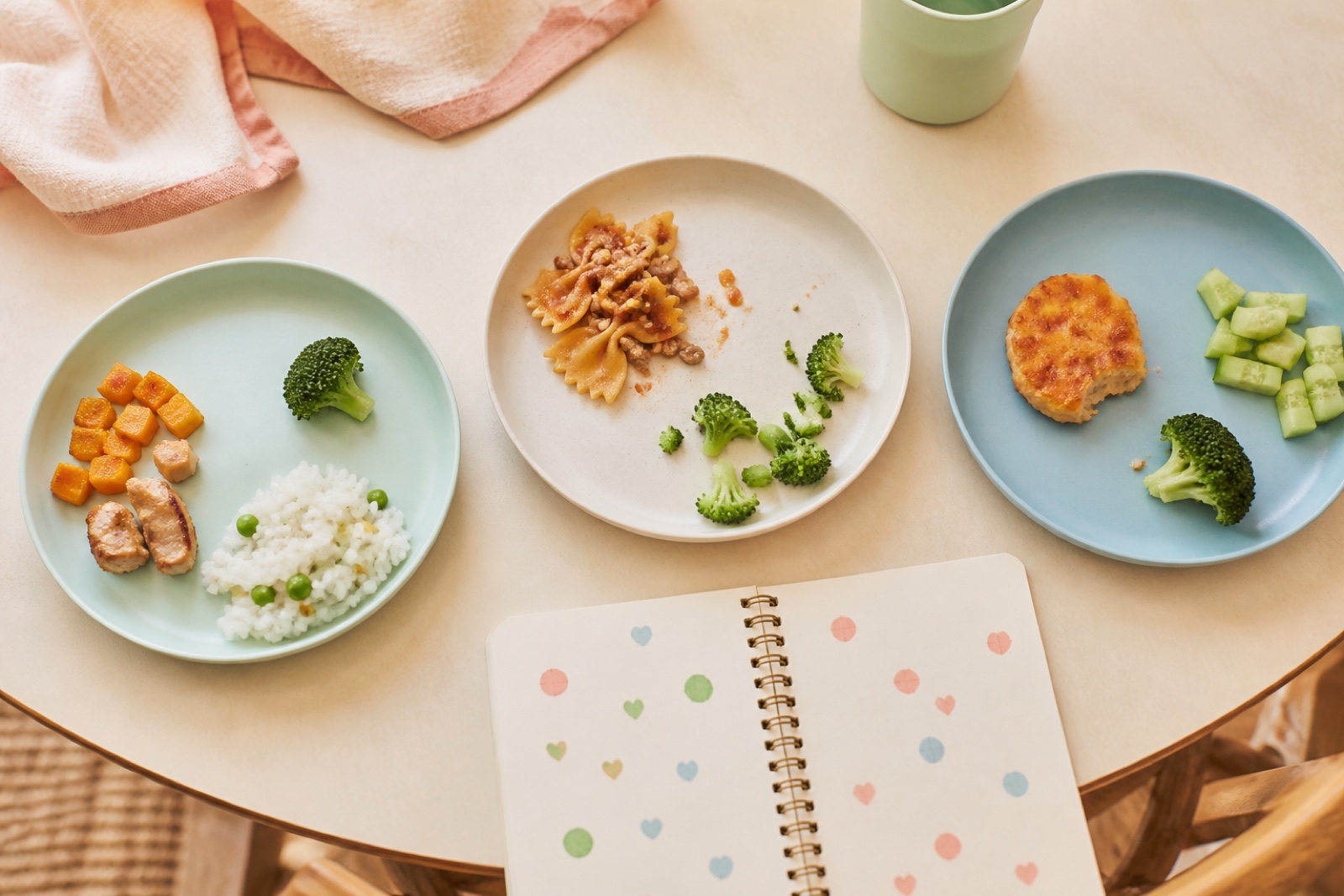
Use two notes instead of one score: offered and response. “Offered broccoli; moved it” is more truthful—and more useful—than “try 6: failed.”
Try eight ordinary offers, not eight tests
If you want a number because a plan makes the week feel lighter, use eight as an observation window, not a finish line. Studies often used daily exposure, but they do not establish one perfect household schedule. Two or three appearances a week may fit family life better. Missed Wednesday? Nothing needs to be restarted or made up.
1. Choose one ordinary target
Pick a food your family genuinely eats and your child can safely manage. “Broccoli” is easier to observe than “more vegetables.” Do not choose a food that has caused a previous allergic reaction for a home experiment, and do not use a texture that is unsafe for your child’s chewing and swallowing skills.
2. Make the portion almost comically small
One soft floret, a pea-sized dab or a thin sliver is enough to be present. More on the plate does not create more familiarity; it can simply make the unfamiliar food feel enormous.
Keep at least one familiar food in the meal. This is not a bargain—“eat broccoli to earn pasta”—but a way to ensure the entire plate does not arrive as a challenge.
3. Keep the first version recognisable
Raw cucumber, grated cucumber and cucumber mixed into yogurt are different sensory experiences. For the first few offers, keep the preparation reasonably consistent so you can see whether familiarity changes. Later, a different cut or preparation may reveal that the problem was texture rather than the food name.
Blended spinach in a muffin may be a perfectly good family food. It simply does not familiarise a child with a visible spinach leaf, so do not count it as the same exposure.
4. Offer; do not conduct
Place the food down, name it once if that feels natural, and return to dinner. Your job is the calm opportunity. Your child does not need to perform smelling, licking or biting for the offer to be worthwhile.
5. Record one line after the meal
Use a note such as:
broccoli · steamed soft · beside pasta · touched top · no taste · tired after daycare
That is enough. The accepted-food list can hold the longer-term status; the seven-day food diary can show whether time, setting or appetite matters more than repetition.
No notebook tonight? Take one plate photo before the meal and add three words afterward: ignored, explored or tasted. You are collecting a pattern, not defending a dissertation.
The sentence after “no” matters more than the sales pitch
Pressure does not always sound harsh. It can arrive wearing a very loving voice:
- “Just one bite for Mummy.”
- “You liked it last Tuesday.”
- “You cannot say no until you taste it.”
- “If you eat this, you can have dessert.”
- “Everyone look—she finally ate it!”
These sentences make sense. They come from worry, effort and the hope that tonight might be easier. But a large longitudinal study of 4,845 families found a two-way loop: fussier eating predicted more parental pressure, and pressure also predicted more later fussiness. The association does not prove that one pressured bite causes picky eating, but it is a good reason to step out of the tug-of-war.
Try language that leaves the door open:
| Instead of | Try |
|---|---|
| “Take one bite.” | “You don’t have to eat it.” |
| “Do you like it?” | “What did you notice?” |
| “Good girl! You ate broccoli!” | “You tried it and decided that was enough.” |
| “But you loved it before.” | “It isn’t working for you today.” |
| “No dessert unless…” | Keep dessert decisions separate from the new food. |
Then talk about something else. Dinosaurs. The neighbour’s dog. The sock that disappeared in the washing machine. A food becomes ordinary partly because it is allowed to sit in an ordinary meal.
What about stickers or rewards?
This is more nuanced than “rewards are always bad.” Some controlled home studies found that a small non-food reward, such as a sticker, combined with tasting increased acceptance of a disliked vegetable. In one randomised trial of 173 children aged 3–4, the sticker condition improved liking and intake, while praise alone was not significantly different from the control group.
That does not mean every kitchen needs a broccoli prize chart. Trials use a defined task and outcome; families live with appetite, temperament and yesterday’s sticker negotiations. Start with calm exposure. If a clinician supporting your child recommends a structured reinforcement plan, follow that individual plan rather than improvising a bigger reward for every bite.
Repeat the opportunity, not the waste
Food waste can make patience feel expensive. The answer is not to make your child finish the portion because you cooked it with love. Try changing the logistics:
- Serve one tiny piece from the family’s food, not a child-sized mountain.
- Keep the rest in the shared serving dish so anyone can take more.
- Use a “no thank you” side bowl if your child dislikes an unfamiliar food touching familiar food.
- Repeat foods already present in your normal shopping and meals.
- Freeze suitable family-sized leftovers before they reach the child’s plate; follow normal food-safety guidance.
- Let an offer be a teaspoon, not a separate recipe.
One parent-led study used 14 daily offers, yet only a minority of families returned the complete outcome data. The researchers concluded that the measurement burden itself was a deterrent. Even science occasionally discovers what mothers already know: a plan that exhausts the adult is not a small plan.
Do not keep serving a large portion so the child “has the chance” to eat more. The chance already exists in one safe, visible piece. Seconds can always appear.
What if offer 20 is still a no?
Stop counting.
You can pause the food for a few weeks and let it return naturally. You can try another preparation later. You can notice whether similar foods are accepted. Or you can accept that this particular food is not welcome right now.
Repeated exposure is a tool for familiarity, not a contract. The evidence does not say every child will learn to like every food. Adults are allowed enduring dislikes; children are people in smaller chairs.
A useful outcome might be:
- the food can remain on the plate without distress;
- your child can say no calmly;
- you can offer it without holding your breath;
- the family still eats together;
- you have learned which texture, setting or preparation changes the response.
That is not lowering the bar. It is choosing a bar that belongs to your family rather than to a viral number.
Pause the experiment when eating looks unsafe or painful
This article is for ordinary food learning, not for testing a suspected allergy or treating a feeding disorder.
Do not repeatedly offer a food at home after hives, swelling, wheezing, breathing trouble or another suspected allergic reaction; follow your child’s allergy plan and seek medical advice. Severe breathing or swelling symptoms require emergency help. The NHS food-allergy guide describes common warning signs.
Prepare food for your child’s developmental skills and supervise eating. The CDC choking guidance recommends avoiding hard, sticky, round or otherwise difficult-to-chew forms and adapting shape, size and texture.
Talk with a pediatrician or qualified feeding professional if you are worried about growth, hydration or nutritional adequacy; if foods are causing pain, recurrent gagging or vomiting, coughing, choking or difficulty chewing/swallowing; or if the accepted range is becoming very restricted or disrupting daily life. Do not wait to complete eight offers before asking.
Keep the memory, lose the scorecard
KidEat can keep one child’s meal notes and plate photos together, including meals at home and school or kindergarten. For this experiment, log the food, preparation and response in one sentence. After eight ordinary offers, look back for change without relying on the emotional memory of the hardest dinner.
The bot’s nutrition estimates are approximate, and it cannot decide whether a feeding concern is medical. The public methodology explains those boundaries.
Source notes
Written by the KidEat editorial team and last checked on 15 August 2026. This article is educational, not medical advice. Research on repeated exposure reports group averages and cannot predict whether or when an individual child will accept a food.
- USDA Nutrition Evidence Systematic Review: repeated exposure and early food acceptance
- 2025 Dietary Guidelines Advisory Committee review: repeated exposure and food acceptance
- Appleton et al.: systematic review and meta-analysis of repeated vegetable exposure
- Fildes et al.: parent-administered exposure randomised controlled trial
- Remington et al.: home taste exposure with non-food incentives
- Jansen et al.: longitudinal study of fussy eating and pressure to eat
- HealthyChildren: helping a picky eater try more foods
- CDC: choking hazards for young children
Questions parents often ask
How many times should I offer my toddler a new food?
There is no guaranteed number. Research often finds improved acceptance after roughly 8–10 or more taste exposures, especially for vegetables, but some children need fewer, some need more and some may never like that particular food.
Does touching or smelling a new food count as an exposure?
It counts as useful sensory familiarity, and research in children aged 2–6 suggests non-taste exposure can improve willingness to try. The strongest evidence for increasing actual acceptance is still repeated tasting, so record what happened rather than treating every contact as the same milestone.
Should I make my toddler take one bite?
A forced bite can turn the meal into a contest. Offer a tiny, safely prepared portion beside familiar food and let your child decide whether and how much to eat. Ask a clinician for individual guidance when feeding is painful, unsafe or severely restricted.